Does poor sleep really raise your running injury risk?
03
/
11
/
2026
5
min read

TABLE OF CONTENTS
Share
related content





Running load is only half the injury equation. The other half is tolerance: how well a runner's tissue can absorb that load on a given day, which is exactly why OnTracx builds load and build-up around the individual rather than a fixed rule of thumb. But tolerance itself isn't fixed either, and few things move it faster, on a week-to-week basis, than a stretch of bad sleep. It rarely gets treated with the same seriousness as pace or mileage in a training plan, even though the evidence linking sleep to running injury is substantial and, for physios guiding return-to-run as much as for runners self-managing their training, worth understanding in some depth.
OnTracx doesn't yet fold sleep into how it calculates load and tolerance; that integration is on our roadmap. What follows is the evidence behind why it belongs there, and a practical way to use it in the meantime.
Too much to read
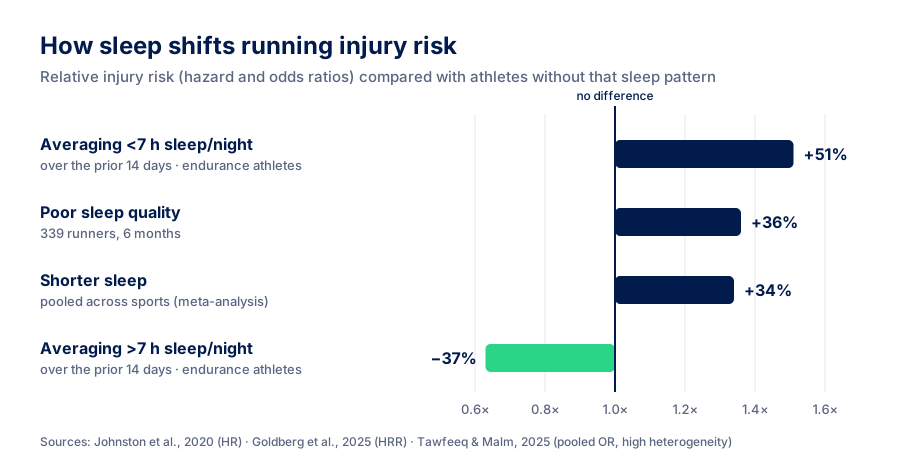
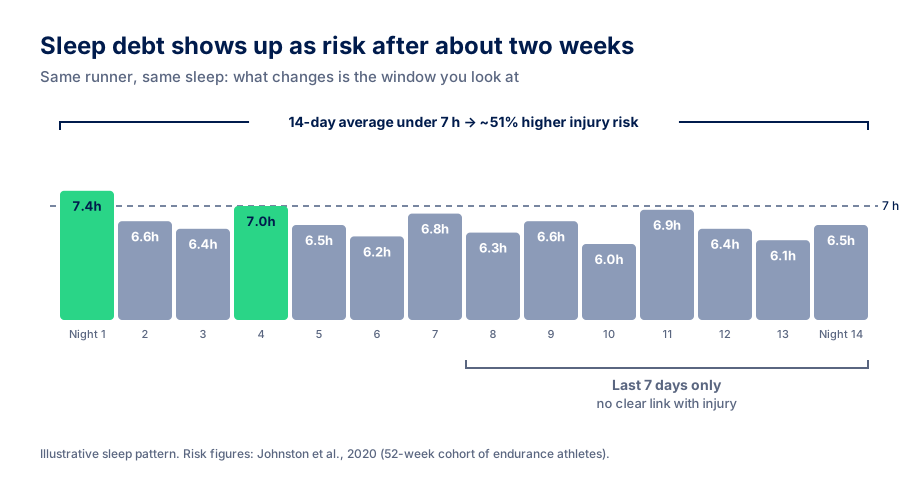
- Runners averaging <7 hours/night over the prior 14 days face a 51% higher hazard of a new injury episode (HR 1.51); averaging >7 hours over the same window was linked to a 37% lower risk (HR 0.63). A 7-day average showed no such link, sleep debt has to build up over roughly two weeks before it shows up as risk.
- Independent of how long someone sleeps, worse sleep quality was linked to a 36% higher injury risk in a 6-month study of 339 runners (HRR 1.36), with soreness and fatigue also climbing in the weeks beforehand.
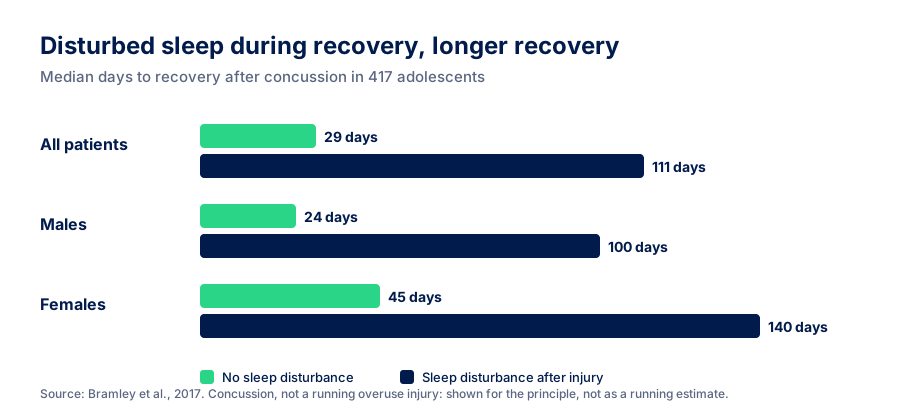
- Fragmented sleep, frequent awakenings rather than too few hours, has separately predicted injury in athletes, and sleep disturbance during recovery has been linked to recovery taking 3–4× longer in some clinical cohorts.
- The common thread: it's rarely one bad night. It's a couple of weeks of degraded sleep, stacked on training load that hasn't adjusted for it. OnTracx doesn't yet fold sleep into its load calculations, but this is an area we're actively working to build into the platform.
Why tolerance deserves as much attention as load
Every runner's build-up is individual in OnTracx: the same weekly mileage can be well within one runner's tolerance and well past another's, depending on history, tissue capacity, and biomechanics. That's the premise the platform is built on. What's easy to forget is that tolerance for a single runner isn't a fixed number either, it moves from week to week, and sleep is one of the clearest, best-studied levers behind that movement.
Sleep works two ways in that picture. It's a marker: when sleep quality drops, it often reflects a system already under strain, training stress, life stress, or early pain, showing up before anything else does. And it's a mediator: poor sleep doesn't just reflect strain, it can actively cause it, by shifting the body toward a less repair-friendly state with more stress signaling, more inflammation, and less of the anabolic hormonal environment that deep sleep normally provides.
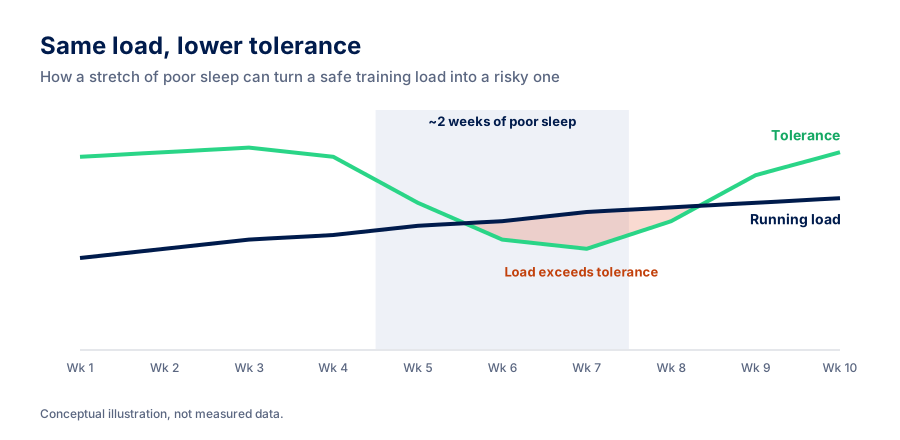
That second point is the one that matters for training decisions. The load itself doesn't change because someone slept badly last week. What changes is how much of that same load the tissue can absorb before it becomes a problem. This is precisely the load-versus-tolerance mismatch that sits behind most running injuries, just approached from the tolerance side rather than the load side.
What the injury-risk evidence actually shows
Three distinct sleep signals show up across the running and endurance literature, and it's worth separating them, because they don't carry equal weight and they don't all point to the same practical advice.
Danger zone isn't missing a night of sleep once. It's living there for two weeks.
Sleep quality looks like the most runner-specific signal. A 6-month prospective study following 339 adult runners across 24 countries found that worse subjective sleep quality was associated with a higher risk of running-related injury (HRR 1.36, 95% CI 1.04–1.78). In that same cohort, muscle soreness was elevated in the two weeks before injury and fatigue in the week before, which is a useful reminder that sleep rarely moves in isolation, it tends to travel alongside other early-warning signals. Interestingly, in this particular cohort, sleep duration itself wasn't clearly associated with injury; quality carried the signal.
Sleep duration matters most as a rolling average, not a single night. A 52-week cohort of endurance athletes (runners, triathletes, swimmers, cyclists, and rowers) found that averaging less than 7 hours a day over the prior 14 days raised the hazard of a new injury episode by roughly 51% (HR 1.51), while averaging more than 7 hours lowered it (HR 0.63). Critically, the same analysis found no association using a 7-day lag: a single short week didn't move the needle, but two consecutive short weeks did. A broader meta-analysis across sports found the same general direction (shorter sleep linked to higher injury odds, pooled OR 1.34), though with considerable variation between the studies pooled into it — a sign that individual context still matters.
Sleep fragmentation is the "I slept, but I didn't recover" problem. In a small actigraphy study of adolescent track-and-field athletes, more wake-after-sleep-onset (time spent awake once already asleep) predicted prior injuries, and more time awake during the night predicted injury occurrence going forward. The sample is small and youth-specific, so it shouldn't be over-extrapolated to adult runners, but the underlying logic holds: hours spent in bed and hours of usable recovery aren't the same thing, especially once pain itself starts interrupting sleep.
Not every study agrees, and that disagreement is informative. A season-long study in high school cross-country runners found no association between week-to-week changes in sleep duration or quality and injury. Read alongside the findings above, this points to a consistent pattern: short-term fluctuation in sleep is far less informative than a settled, multi-week baseline. A single rough night isn't the signal worth acting on, a persistent pattern is.
The danger zone isn't missing a night of sleep once. It's living there for two weeks.
Sleep during recovery: a modifier, not a side note
Direct trials that test sleep as the main lever in return-to-running rehab are still limited, but the surrounding evidence is consistent enough to treat sleep status as a genuine recovery modifier once a runner is already injured, a detail that matters as much for the physio guiding a return-to-run progression as for the runner living through it.
The clearest example comes from outside running: in a cohort of 417 adolescents recovering from concussion, sleep disturbance after injury was associated with recovery taking roughly 3 to 4 times longer (median 111 days versus 29 days). Concussion isn't an overuse running injury, but the underlying principle travels well, when sleep is disturbed during recovery, symptoms tend to linger regardless of the tissue involved.
There's mechanistic support for why. In a controlled preclinical overuse-injury model, animals with post-injury sleep disturbance kept elevated mechanical pain sensitivity, while those given voluntary exercise returned toward baseline sensitivity, with or without concurrent sleep disturbance. Reviews of the underlying hormonal and immune pathways point the same direction: slow-wave sleep coincides with peak growth hormone release and an anabolic, repair-friendly state, while sleep restriction pushes the body toward higher stress hormones, more systemic inflammation, and greater pain sensitivity. In practice, that's exactly the biological backdrop that can make an identical training load feel, and act, like more than it should.
A practical way to use this, and where OnTracx is headed
None of this supports treating sleep as a strict go/no-go rule on its own. It's one input among several, alongside pain, soreness, and recent load changes, the same variables OnTracx already helps runners and physios track. And to be transparent about where the product stands today: OnTracx doesn't currently measure or factor sleep into its load or tolerance calculations. It's a genuine gap. But we are closing it, building sleep status into how tolerance is estimated, is on our roadmap in September 2026. As far as we're aware, few if any tools in this space currently account for sleep at all, even in a simple form, so this is an area where OnTracx aims to be an early mover rather than a fast follower.
Until that's built in, the evidence above translates into a simple manual framework runners and physios can layer on top of a training or rehab plan:
- Green — sleep is roughly normal for that runner, in both duration and quality, with no rising soreness or fatigue: run as planned.
- Yellow — averaging under 7 hours a night across roughly two weeks, or a clear worsening in sleep quality, especially alongside rising soreness or fatigue: keep the volume where possible, but reduce the risk: swap intensity for easy running, and skip speedwork, hills, or plyometrics.
- Red — sleep is clearly disrupted and other warning signs are stacking (rising pain, altered mechanics, unusual fatigue): reschedule the impact-loading session rather than pushing through it.
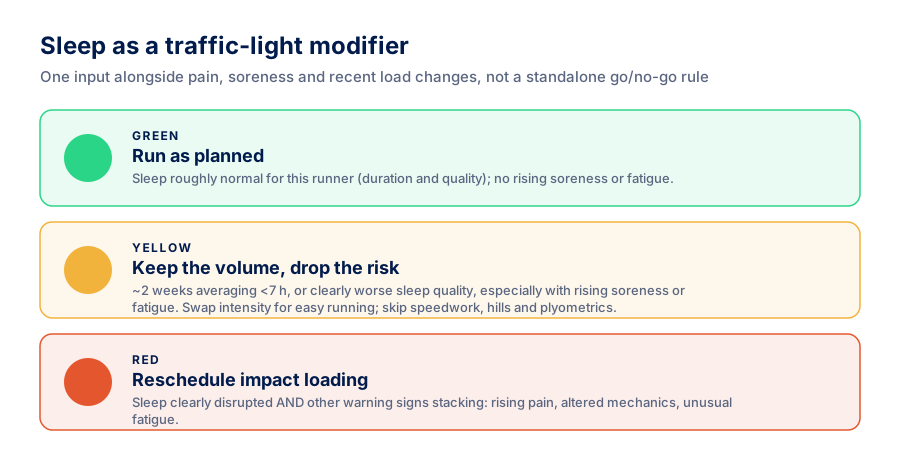
A single bad night can still justify making a hard session easier. But the stronger signal, and the one worth building a habit around, is a trend: a couple of weeks of degraded sleep, especially alongside rising soreness and fatigue.
Take-home message
Load and tolerance move at different speeds, and sleep is one of the fastest-moving parts of tolerance, which is exactly why a training plan that only tracks load and ignores tolerance is incomplete. The clearest evidence here isn't that one rough night causes an injury; it's that a couple of weeks of poor sleep quality or short sleep duration measurably raises the odds, and that disturbed sleep during recovery can slow healing down. OnTracx already measures the load half of that equation precisely, for every runner individually. Sleep is one of the clearest next steps on the tolerance half, and while it isn't part of the algorithm yet, treating it as a genuine factor today, rather than an afterthought, is the closest available way to read load data the way it's meant to be read: against a tolerance that isn't fixed.